
There is a quiet assumption that sits underneath many of our everyday food choices, and it rarely gets questioned. It is the idea that we can recognise what is healthy simply by looking at it, or by relying on how it has been positioned to us over time. Foods that feel familiar, convenient, or widely accepted tend to fall into this category almost automatically, and once they do, they are no longer examined very closely.
This is where the disconnect begins.
Because when people reflect on their diets, they tend to exclude these foods from scrutiny. The focus usually shifts to the obvious outliers, sugar in coffee, desserts, and the occasional treat, while the foods that make up the bulk of daily intake are assumed to be neutral or even beneficial. In this context, it becomes entirely reasonable for someone to say that they do not consume much sugar because the reference point they are using is incomplete.
What is often missing from that assessment is an understanding of how modern food products are constructed. Many foods that are perceived as healthy or appropriate for regular consumption are, in reality, combinations of refined carbohydrates and added sugars, designed for palatability, shelf life, and convenience. These are not always perceived as “sweet” in the traditional sense, and they are rarely labelled in a way that prompts closer inspection. As a result, their contribution to overall sugar intake and glycaemic load tends to go unnoticed.
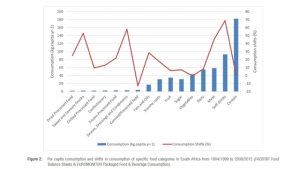
When dietary patterns are examined at a population level, this becomes more apparent. Shifts in consumption have not occurred in isolation, but alongside a broader move toward processed and packaged foods, sugar-sweetened beverages, and products that prioritise convenience over composition. Within this environment, sugar is no longer confined to discrete categories. It is distributed across the food system, embedded in products that are consumed daily and often perceived as routine (1).
The implication of this is not simply that people are eating more sugar, but that they are doing so in a way that is less visible and therefore less likely to be recognised or moderated. This has important consequences from a metabolic perspective, particularly when exposure is frequent and cumulative. Foods that are rapidly digested and absorbed contribute to repeated elevations in blood glucose and insulin, even when they are not consciously identified as sources of sugar. Over time, this pattern becomes part of the background of daily life, rather than something that stands out as a specific dietary choice.
This is where awareness becomes meaningful, not in the sense of restriction, but in the sense of clarity. Understanding what is actually being consumed requires a shift in attention away from what is assumed to be healthy and toward what is present in the food itself. This is not always intuitive, particularly in a food environment where marketing, labelling, and long-standing habits shape perception as much as nutritional content.
Food labels offer one of the few objective points of reference. They provide a direct view of how products are formulated, including the presence of added sugars and the overall carbohydrate composition. For many people, this is where the realisation begins, not through dramatic changes, but through small, repeated observations that challenge existing assumptions. A product that was considered a default choice is reconsidered. A routine purchase is viewed differently. A pattern that once went unnoticed becomes visible.
World Health Month is often framed around large-scale change, but there is value in focusing on something more immediate and practical. Before changing what we eat, there is a need to understand what we are already eating and how those foods align with the outcomes we are trying to achieve.
Because the issue is not always as excessive as we imagine it. It is often exposed in the places we are not looking.
And once that becomes visible, the conversation around health begins to shift in a much more meaningful way.
References
Ronquest-Ross, L.-C., & Sigge, G. O. (2024). South Africa’s food system: An industry perspective on past, present and future applications of science and technology. South African Journal of Science, 120(7/8), Article #16536. https://doi.org/10.17159/sajs.2024/16536